
Welcome letter to students summer 26
13.04.2026
Dear students of English and American Studies at JMU Würzburg,
A warm welcome to all of you on behalf of the English and American Studies department at the beginning of this summer semester 2026!
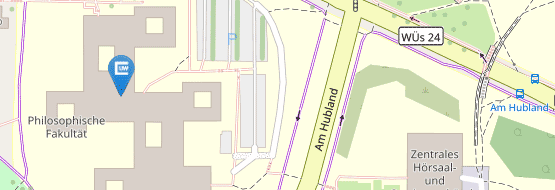
To those of you joining us for the first time, I’d like to extend a warm welcome on behalf of all colleagues. We hope that you will soon feel at home at JMU and actively engage in our community of readers, thinkers, researchers, writers, and learners. The building may look like a construction site from the outside (and soon there will be further construction sites inside…), but we hope you will find some warmth and inspiration inside – in our classes, lectures, seminars, and other activities.
To those who have been studying with us for some time, we look forward to seeing you again in our classes, on the hallways, in town and elsewhere. I would like to especially thank those of you who contribute to the many extracurricular activities organized at the department, e.g., the Fachschaft, the English Drama Groupe, the Little Book Club, pub quizzes, summer parties, and many, many more.
In this letter, I’d like to share some important information with you:
- The registration period for classes has been brought forward in response to the last student survey. Thanks again to all students who participated in the survey!
- The allocation of remaining free places in the first session of courses may still possible from April 15. Please be sure to attend the first session in person for this purpose.
- Please double-check EARLY and REPEATEDLY which modules and courses you need, especially in the "Wahlpflichtbereich". There have have been repeated issues with students who want to register for their state exam and found that they did not have the required modules. Check out which modules (e.g., "thematisch-historisch" vs. "theoretisch") you need for your couse of study. You will find this information in your study requirements (Studienordnung) and the "Fachspezifischen Bestimmungen" (FSB) and here especially in the "Studienfachbeschreibungen" (SFB). You can find these on our website in the "Studium" section. Also make sure you select the correct versions of the FSB and SFB applicable to your start of studies. Note that different versions may be applicable if you have changed your degree program or subjects in the past.
- Before the start of each semester, compare your performance overview from WueStudy with the „Studienfachbeschreibung“ (SFB) of your degree program. Do not exclusively use the „Studienverlaufsplan“ (SVP) for your semester planning.
- An easily accessible overview of the courses currently offered by the Department of English and American Studies can be found on our website: https://www.neuphil.uni-wuerzburg.de/anglistik/study-programmes/lehrveranstaltungsangebot-course-offerings/
- Remember to register for exams if you would like to receive credit points. You must also register for an “exam” if the course requirement is a research paper, a portfolio, etc.
- Write term papers, presentations and all other assignments yourselves! All forms of plagiarism and AI-generated papers will result in failure (see: https://www.neuphil.uni-wuerzburg.de/fileadmin/04110100/2024/Selbstaendigkeitserklaerung_AngAm_25-6-24.pdf)
- If you would like to get advice on academic writing, the ‘Schreibzentrum’ offers courses: https://www.uni-wuerzburg.de/schreibzentrum/
- Our Erasmus programme offers excellent opportunities to go abroad every year, e.g., to Cambridge, Liverpool or Warwick. Check out: https://www.neuphil.uni-wuerzburg.de/anglistik/study-programmes/auslandsaufenthalt/
- Use your university email address for all university-related communication.
Finally, I would like to reiterate how important it is to be critical thinkers and life-long learners at this time and age. We live in an age of fake news, populist discourses and AI-generated information that poses as the result of thinking. Certain people use the opportunity to twist language and its meaning into ways that are opportune for some, and hurtful to many others. In his classic Through the Looking-Glass, and What Alice Found there (1871), Lewis Carroll narrates an episode where the famous Humpty Dumpty meets Alice and wants to take control of language in a way that gives reason to pause even today.
Humpty Dumpty took the book, and looked at it carefully. “That seems to be done right—” he began.
“You’re holding it upside down!” Alice interrupted.
“To be sure I was!” Humpty Dumpty said gaily, as she turned it round for him. “I thought it looked a little queer. As I was saying, that seems to be done right—though I haven’t time to look it over thoroughly just now—and that shows that there are three hundred and sixty-four days when you might get un-birthday presents—”
“Certainly,” said Alice.
“And only one for birthday presents, you know. There’s glory for you!”
“I don’t know what you mean by ‘glory,’” Alice said.
Humpty Dumpty smiled contemptuously. “Of course you don’t—till I tell you. I meant ‘there’s a nice knock-down argument for you!’”
“But ‘glory’ doesn’t mean ‘a nice knock-down argument,’” Alice objected.
“When I use a word,” Humpty Dumpty said in rather a scornful tone, “it means just what I choose it to mean—neither more nor less.”
“The question is,” said Alice, “whether you can make words mean so many different things.”
“The question is,” said Humpty Dumpty, “which is to be master—that’s all.”
[…]
“When I make a word do a lot of work like that,” said Humpty Dumpty, “I always pay it extra.”
(Carroll Lewis, Through the Looking-Glass, Chapter VI)
At the beginning of the new summer semester 2026, I wish us all the courage of challenging Humpty Dumpties wherever we meet them – inside and outside of university.
No matter which classes you take – Linguistics, Teaching English as a Foreign Language, American or English Literature and Culture – we all have the opportunity to critically engage with stories, other worldviews and other fields of learning and thinking. As lecturers and researchers, we are equally interested in your perspectives and thoughts. So please, be an active participant in our classes at this institution of teaching, learning and research!
I wish you – and all of us – a successful and inspiring start into the new semester!
Kind regards,
Prof. Dr. Kirsten Sandrock
(Chair of the English Department)