![[Translate to Englisch:]](/fileadmin/_processed_/1/d/csm_BuecherII_Slider_7739a27950.jpg "[Translate to Englisch:]")
Global Education in the EFL Classroom
Global education plays a crucial role in today’s EFL classrooms, offering students a unique and comprehensive learning experience that extends beyond linguistic proficiency. Focusing on global topics equips students with the skills necessary to engage in international dialogue and collaboration. It goes beyond pure acquisition of vocabulary and grammar teaching, emphasising the development of critical thinking, problem-solving, and cross-cultural communication skills. In an interconnected world where borders are increasingly porous and communication spans continents, fostering global awareness is essential for preparing students to navigate the complexities of our globalised society.
One of the primary benefits of global education in the language classroom is the cultivation of cultural competence. Language and culture are intricately intertwined, and a deep understanding of both is essential for effective communication. By exposing students to diverse cultural perspectives, customs, and traditions, global education enriches their language learning experience in terms of inter- and transcultural learning, making it more authentic and meaningful.
In consequence, global education in the EFL classroom promotes empathy and open-mindedness. Students not only gain insights into the lives of people from different corners of the world, they also learn to foster a sense of shared humanity and how to deal with challenging stereotypes. This exposure to diverse perspectives helps break down cultural barriers, encouraging students to approach an open-minded communication.
In an era marked by global challenges, such as pandemics, climate change, and economic disparities, this ability to empathise and collaborate across borders is more important than ever.
Moreover, global education fosters a sense of global citizenship. Students learn to appreciate the interconnectedness of global issues and the role they can play in addressing them. This awareness empowers them to become informed and responsible global citizens who are capable of contributing positively to the world. By incorporating global learning, teachers can enhance the development of young people who have a broad global awareness and are ready to face the challenges of the 21st century.
Networking at JMU: Education for Sustainable Development in Teaching
Motivated by the “Tag der Lehre” in November 2021, with the topic "Education for Sustainable Development" – or briefly, ESD – many colleagues have engaged in an interdisciplinary exchange about the significance and integration of ESD in teaching at JMU. Since the summer term 2022, the network "SDG in University Teaching" has evolved, focusing on the various dimensions and imparting design competencies that constitute successful ESD.
To achieve this goal, the TEFL Chair collaborates closely with the JMU team of the Teaching4Sustainability transformation experiment. Together, we contemplate what future-oriented teaching should look like, what guidelines are necessary, and how we can shape them at JMU.
The initial results regarding sustainability in teaching are already visible. Sustainability in teaching has been anchored in the new university contract, quality goals for teaching are currently being revised, and the processes initiated as a result are being co-shaped collaboratively and further explored within the framework of higher education.
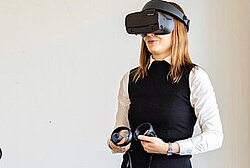
In interdisciplinary cooperation with the Zentrum für wissenschaftliche Bildung und Lehre (ZBL), the Naturerlebniszentrum Rhön and teacher training departments of Biology, Geography and German, our Chair has been working on the project "VR for ESD" since summer term 2022. This involves the development of virtual reality learning environments with a focus on sustainability goals and global learning, whereby the potential of VR with regard to the acquisition of sustainability-specific skills and successful ESD learning processes is discussed and analysed.
Frames of reference are the following:
Oxfam (1997/ 2015): Curriculum for Global Citizenship
UNESCO (2015): Model of Global Citizenship Education
Council of Europe (2018): Reference Framework of Competences for Democratic Culture
OECD (2018): Global Competence Framework
The TEFL Chair’s focus is on fully immersive learning environments for intercultural encounters in foreign language teaching. To this end, a seminar concept was developed for advanced students in the teacher training. There, the participants gain insights into
- the current state of research in intercultural and transcultural teaching and learning
- research in modern foreign languages
- acquire skills in using VR in theory and practice sessions.
The aim is to develop teaching concepts in VR for upper secondary schools that focus on the development of inter- and transcultural competences with a focus on education for sustainable development against the background of racism-critical foreign language teaching. This is accompanied by surveys that provide insights into how the VR environment works and its potential for the developed teaching-learning scenarios.
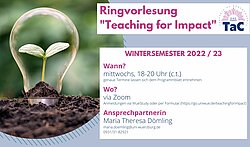
As part of the Teachers as Changemakers (TaC) project, a lecture series is taking place in which all interested parties will have the opportunity to find out more about social entrepreneurship in the school setting, learn about specific methods and projects and take away food for thought for their own lessons. Further information on the presentations can be found in the programme sheet.
WS23/24: Topics and Registration
On Wednesday, 21 December 2022, Prof. Dr Maria Eisenmann gave a lecture on "Critical Animal Pedagogy and Global Education in the EFL Classroom" in the lecture series "Teaching for Impact" as part of the TaC project. Click here for more information.
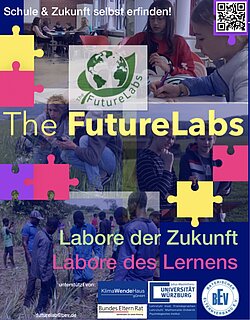
Since 2022, the TEFL Chair has been accompanying and evaluating the ESD (Education for Sustainable Development) project "Schule als Zukunftslabor" at the Walther-Rathenau-Gymnasium and Realschule Schweinfurt. In collaboration with a partner school in Ghana, the concept of "FutureLabs" is being developed by teachers, climate research institutes, the Bavarian Parents' Association, and our department. The focus of the research is on ESD project-based teaching, which becomes part of everyday school life through self-directed, interdisciplinary, local sustainability projects with external partners.
Check out the einBLICK-Artikel: Englischunterricht: The FutureLabs
Website The Future Labs: The FutureLabs
Tagesthemen-edition from the 12.12.2023 „Tagesthemen mittendrin“: Mit neuem Unterrichtskonzept gegen den Klimawandel

In view of the planetary threat posed by human-caused ecological damage and disturbing warnings from the scientific community as well as social movements such as Fridays for Future and Extinction Rebellion, it should come as no surprise that the role and significance of education for sustainable development are becoming more and more recognised in educational research and policy documents. This is where the concept of global and ecological education comes into play, which is based on the literary and cultural orientations of ecocriticism and provides an essential contribution to the discourse of global teaching of English as a foreign language (EFL).
Literary texts from the genre of the (young adult) dystopian fiction are ideal for this purpose. In their contemporary realisations, they offer multiple opportunities to discuss global concerns and thus enhance critical thinking and active engagement with the scenarios portrayed. Through their combination of exciting coming-of-age tales, romantic elements, and adventure stories with socially relevant questions, the texts address adolescents
and young adults very directly on the one hand, but on the other hand also contain elements of cultural and social criticism that can be fruitful for teaching.
In addition to topics such as social (in)justice, political oppression, surveillance or the challenges of the increasing mechanisation of society, many texts also deal with the consequences of climate change, waste of resources, and environmental pollution, or fundamentally consider the relationship between man and the environment.
In our research we make a case for the importance of literature pedagogy in times of unprecedented crisis. On the basis of selected text examples, it is explored how dystopias can contribute to a closer link between English teaching and approaches such as education for sustainable development, ecological education, and environmental literacy.
Find out more on the dedicated Environmental Humanities website.
Eisenmann, M. (2023). Developing Global Environmental Citizenship through Teaching Contemporary Dystopian Fiction. in Amerstorfer, C. M. & von Blanckenburg, M. (Eds). Activating and Engaging Learners and Teachers, S. 339-356, Narr.
Eisenmann, M. (2023). Critical Animal Pedagogy and Global Education in the EFL Classroom. in Ludwig, C. & Summer, T. (Eds). Taboos and Controversial Issues in Forgein Language Education. Critical Language Pedagogy in Theory, Research and Practice, S. 181-194. Routledge. 2023, 181-194. DOI: 10.4324/9781003220701-20
Eisenmann, M. & Krüger, N. (2021). Environmental Education in the EFL Classroom Through Young Adult Dystopian Fiction. in Ludwig, C. & Deetjen, C. (Eds).The World Beyond. Developing Critical Environmental Literacies in ELT, S. 85-103, Winter.
Eisenmann, M. (2020). The Potential of Postcolonial (Poverty) Literature in the EFL Classroom. Ißler, R. & Küchler, U. (Eds). Impulse zur Fremdsprachendidaktik – Issues in Foreign Language Education. Wissenschaft und Lehrerbildung, 5, S. 391-408, Vandenhoeck & Ruprecht.
Eisenmann, M. (2018). The potential of Young Adult Dystopian Fiction. Ludwig, C. & Maruo-Schröder, N. (Eds). Tell freedom I said hello: Issues in Contemporary Young Adult Dystopian Fiction, S. 137-159, Winter.
Eisenmann, M. (2015). Crossovers – Postcolonial Literature and Transcultural Learning. in Delanoy, W., Eisenmann, M. & Matz, F. (Eds). Learning with Literature in the EFL Classroom, S. 217-236, Lang.
Eisenmann, M. (2011). Intercultural Competences. Raising Cultural Awareness in University Literature Courses. in Bauder-Begerow, I. & Schäfer, S. (Eds). Learning 9/11.Teaching for Key Competences in Literary and Cultural Studies, S. 123-150. Winter.
Eisenmann, M., Grimm, N. & Volkmann, L. (2010). Introduction: Teaching the New English Cultures and Literatures. in Eisenmann, M., Grimm, N. & Volkmann, L. (Eds). Teaching the New English Cultures and Literatures, vii-xiii, Winter.