
![[Translate to Englisch:]](/fileadmin/_processed_/1/d/csm_BuecherII_Slider_7739a27950.jpg "[Translate to Englisch:]")
Differentiation, Individualisation and Inclusion in the EFL Classroom
In research, there is agreement that the times of homogeneous learning groups (if they have ever existed) are gone forever. Heterogeneity in the classroom is perceived as a challenge, sometimes as a burden, as a necessity as well as an opportunity in all types of schools. Consequently, increasing demands for differentiation and individualization in the classroom are to be stated in policy and curricular requirements of all federal states. Despite the great social and (school) political relevance of the issue of heterogeneity, diversity and inclusion, the field of foreign language teaching neither offers an empirically grounded theory nor a concrete conceptualization.
Numerous normative models for differentiated instruction and inclusive models for dealing with heterogeneous learning groups have so far been mainly presented on a general educational and pedagogical level, rarely with reference to the teaching of foreign languages. In view of the many demands for differentiation, now even for inclusion, in the foreign language classroom the empirical basis for the question of awareness and dissemination of differentiating, individualising and including learning arrangements is amazingly thin. There is as yet little/almost no empirical research on the question which differentiating and including measures language teachers in task-based and standard-oriented learning contexts currently rely on. To close this gap in foreign language teaching, the central interest of this research project is to gain empirically based insights which differentiating, individualising and including learning arrangements teachers of all modern languages use in their everyday teaching and what they consider to be particularly profitable. The following questions are investigated:
(1) Which differentiating and including measures and techniques are known?
(2) Which differentiating, individualising and including learning arrangements are used in different types of schools and different grade levels?
(3) What materials are used in order to differentiate?
(4) What methods are considered to be particularly profitable or particularly inappropriate?
Through a web-based Germany-wide empirical data collection and evaluation for all school types useful insights of a possible match or mismatch between the far-reaching expectations and the practical implementations in differentiating modern foreign language teaching (English, French, Italian, Spanish) will be obtained in this study. After evaluating the data, in a second step targeted measures to implement differentiating and individualizing methods should be proposed and evaluated in triangulation accesses of qualitative and quantitative approaches.
National Collected Data
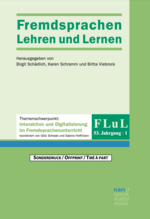
Prof. Dr. Eisenmann's contribution presenting the German-wide collected data can be found here.
Monograph
Eisenmann, M. (2019). Teaching English: Differentiation and Individualisation. UTB Schöningh.
Books edited
Eisenmann, M. & Grimm, T. (Eds). (2011). Heterogene Klassen – Differenzierung in Schule und Unterricht. Schneider Hohengehren.
Eisenmann, M. (Ed). (2011). Differenzierung im Englischunterricht. Eichstaett Academic Press.
Contributions
Eisenmann, M. (2024). Differenzierung und Individualisierung im Fremdsprachenunterricht - Ergebnisse einer deutschlandweiten schulübergreifenden Befragung von Fremdsprachenlehrkräften. In Schädlich, B., Schramm, K. & Viebrock, B. (Eds.). Fremdsprachen Lehren und Lernen. FLuL 53. Jahrgang (1).Narr.
Eisenmann, M. & Steinbock, J. (2024). Diversity in the Foreign Language Classroom: A Social Virtual Reality Project. In L. Mañoso-Pacheco, J. Estrada Chichón, & R. Sánchez-Cabrero (Eds.), Inclusive Education in Bilingual and Plurilingual Programs (pp. 265-280). IGI Global. https://doi.org/10.4018/979-8-3693-0563-8.ch014
Eisenmann, M. & Summer, T. (2023). Diversity in ELT. Einen Englischunterricht der Vielfalt gestalten. in Theresa Summer (Ed). Embracing diversity Englisch 5-10, 63, S. 28-33, Friedrich.
Eisenmann, M., Gerlach, D., Vogt, K., Blume, C., Chilla, S., Doetjes, G., Engelen, S., Heine, L., Küppers, A., Marx, N., Schmidt, T., Mertens, J., Springob, J., Wieland, K. & Wilden, E. (2021). Inklusiver Fremdsprachenunterricht: Positionspapier der Deutschen Gesellschaft für Fremdsprachenforschung (DGFF). Zeitschrift für Fremdsprachenforschung, 32(1), S. 3-9.
Eisenmann, M. (2021). Differentiation Through Digital Teaching and Learning. in Lütge, C., Merse, T. (Eds). Digital Teaching and Learning: Perspectives for English Language Education, S.103-123, Narr.
Eisenmann, M. (2018). Differentiation and Individualisation through Digital Media. in Van de Poel, K. & Ludwig, C. (Eds). Collaborative Language Learning and New Media: Insights Into an Evolving Field, S. 73-86, Lang.
Eisenmann, M., Hoffmann, L., Schröter, P. & Thaler, E. (2019). Abiturstandards und gemeinsames Abitur ab 2017. in Falkenhagen, C., et al. (Eds). Sprachen lernen integriert – global, regional, lokal. S. 461-463, Schneider Hohengehren.
Eisenmann, M. (2017). Heterogeneity and Differentiation – Individualization in the EFL Classroom". in Eisenmann, M. & Summer, T. (Eds). Basic Issues in EFL Teaching and Learning. S. 297-310, 3. aktualisierte Auflage, Winter.
Eisenmann, M. (2017). Differenzierung und Individualisierung mit Web 2.0 Tools. in Solveig, H. & Vogt, K. (Eds). Heterogenität und Diversität im Englischunterricht – fachdidaktische Perspektiven. S. 155-178, Lang.
Eisenmann, M. (2016). Binnendifferenzierung. in Burwitz-Melzer, E. et al (Eds). Handbuch Fremdsprachenunterricht S. 358-361, Francke UTB.
Eisenmann, M. (2013). Binnendifferenzierung im Englischunterricht – Chancen und Herausforderungen. in Gehring, W. & Merkl, M. (Eds). Neue Perspektiven für den Englischunterricht.
Eisenmann, M. (2013). Offene Formen der Leistungsmessung – Portfolios auch für schwächere Lerner. Praxis Fremdsprachenunterricht, 3, S. 15-18.
Eisenmann, M. (2012). Leselust statt Lesefrust – Textarbeit in heterogenen Lerngruppen. Praxis Fremdsprachenunterricht, 2, S. 13-16.
Eisenmann, M. & Grimm, T. (2011). Umgang mit Heterogenität in Schule und Unterricht – eine kritische Bilanz. in Eisenmann, M. & Grimm, T. (Eds.) Heterogene Klassen – Differenzierung in Schule und Unterricht, S. 241-247, Schneider Hohengehren.
Eisenmann, M. (2011). Differenzierung im Englischunterricht. in Eisenmann, M. & Grimm, T. (Eds). Heterogene Klassen – Differenzierung in Schule und Unterricht, S. 79-98, Schneider Hohengehren.
Eisenmann, M. (2011). Bildungsstandards und Kompetenzorientierung versus Individualisierung und Differenzierung – ein Dilemma für den Fremdsprachenunterricht? in Eisenmann, M. (Ed.) Differenzierung im Englischunterricht, S. 13-32, Eichstaett Academic Press.