
Refugee Support and Integration Projects
In cooperation with local Institutions our department is involved in projects supporting people with refugee backgrounds, with a particular focus on integration, participation, and participatory research. At the core of these efforts are educational and language support initiatives for refugee children and adolescents, alongside innovative collaborative formats that bring together academia, the arts, and civic engagement. Together with students, faculty, and civil society partners, we create spaces for dialogue, knowledge exchange, and the co-creation of a more inclusive society.
Connect and Create: Your Path to Resilience and New Futures
Start Your Journey to Healing and Growth!
This program is a series of easy-to-join, creative online evening sessions designed specifically to support your psychological condition and emotional state. We aim to enhance your German and English language skills while leveraging your native Ukrainian language skills. You will work with university students and professors on exciting, hands-on projects in a safe space for healing and growth across borders.
This project takes place in cooperation with the Malteser Hilfsdienst e.V. and will go on from January - May with two monthly sessions
January: Finding Our Feet and Future
1. Welcome and My Story: Focus on collaborative group work and creative digital projects to discuss language, identity, and belonging. Share your personal journey in an inclusive environment!
2. Teen Future Planner: A hands-on, bilingual session (Ukrainian-German). We use UNO cards for self-discovery, "Workipolia Games" to learn simplified labour rights, and comics to review interview essentials. Receive initial practical job-preperation insights and self-reflect on your skills!
February: Art and Emotion
1. Art from the Everyday: Based on "Waste to Words," we analyse visual art and turn everyday materials into artistic expressionsthat tell stories about the environment and cultural values. Foster environmental consciousness and intercultural dialogue through creativity!
2. My Feelings Map: Drawing from "The Art of Feeling," we use personal storytelling, visual art, and multimedia expression to reflect on how emotions are expressed across cultures (using Ukrainian/German/English/Chinese/Korean materials). Build emotional intelligence by revealing how culture shapes the way we connect with others!
March: Voice and Healing
1. Speak Up & Shine: Rooted in "Everyday Feminism," we use artistic expression, drama, and performance to challenge gender stereotypes and confront everyday sexism. Be empowerd you to reclaim your voice and foster inclusive perspectives through language and art!
2. Healing Through Creation: Based on "Art Meets Society," we use visual art, poetry, and multimedia storytelling to process collective trauma and imagine paths toward healing and solidarity. Create a platform for resilience and remembrance, showing how creativity illuminates human experiences!
April: Identity and Belonging
1. Language, Identity, and Joy: We explore stories across generations in three languages (Ukrainian, German, English), reflecting on how language serves as memory and a lifeline in the migrant experience. Understand the profound connection between your language, your identity, and your well-being!
2. My Personal Mandala: Engage with the "Self Circled" multimedia project (Ukrainian/English) where you create personal mandalas (visual art/video/sound blends) to reflect on cultural hybridity and life after migration. Explore and express your complex identity and encourage self-directed learning!
May: Looking Forward
1. Our Journey Shared: A collective reflection session where participants share their favourite projects and discuss how creativity and multilingualism helped them build emotional resilience. Celebrate individual and collective achievements and reinforce the sense of a shared community!
2. Planning My Next Steps: We will discuss future aspirations, linking personal growth to broader themes of social change, and brainstorm next steps for personal growth and community involvement. Tackle future challenges and receive a sense of closure and future direction within a supportive community!
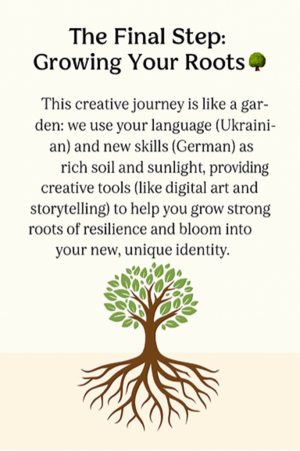
The "Connect & Create" initiative functions as a methodology for participatory research and constructive civic engagement, effectively operationalizing concepts of citizen science and volunteering within the context of forced migration and displacement. The programme is built upon the framework of transcultural project-based learning, engaging participants alongside university faculty and students in collaborative activities that result in the co-creation of knowledge. By using multimedia art, storytelling, and collective reflection to process collective trauma and explore cultural hybridity, participants voluntarily contribute valuable qualitative data regarding resilience, identity, and multilingual communication. This hands-on process of data collection and processing, focused on complex themes like challenging stereotypes and promoting inclusive perspectives, positions participants as essential contributors to academic discourse and social change.
The connection of this initiative with both society and academia is critically important, yielding mutual strategic benefits through the following three objectives:
1. Establishing Pedagogical and Therapeutic Rigour and Validation:
- Direct cooperation between Julius-Maximilians-Universität Würzburg and partner Ukrainian Universities ensures the foundational concepts are validated within academic and professional contexts. This relationship guarantees the programme’s methodologies focusing on emotional resilience and the processing of collective trauma are evidence-based and possess sound pedagogical and therapeutic rigour.
- Provides material for scholarly dissemination, such as conferences, and empirical validation of transcultural project-based learning approaches.
- Assures that participants receive effective, accredited support designed to enhance their psychological condition and emotional state.
2. Fostering Evidence-Based Policy and Systemic Advocacy:
- The project’s outputs are designed to transcend personal support, aiming to inform state language policy and foster multicultural communication. By linking personal growth to broader themes of social change, the initiative translates lived experiences into actionable insights.
- Generates vital, context-specific evidence required for developing policy recommendations concerning linguistic identity and integration in migrant populations.
- Empowers individuals by ensuring their collective experiences contribute directly to positive systemic reform, fostering inclusive perspectives in policy and public discourse.
3. Advancing Research in Multilingualism and Cultural Hybridity:
- The collaborative structure provides a unique, cross-border laboratory for investigating the complex interplay of multilingual communication (Ukrainian, German, English, and others) and the construction of identity and belonging. Activities centered on creating personal mandalas explicitly investigate cultural hybridity after migration.
- Offers rich, qualitative data for scholarly research concerning linguistics, cultural studies, and the migrant experience.
- Provides a structured, safe platform for individuals to explore and express their complex identity and language connections, reinforcing their sense of self and well-being.
Lazebna, N. (2025). Artificial intelligence in transcultural language education: Enhancing the linguistic competence and creativity of future foreign language teachers. Nova filolohiia. Zbirnyk naukovykh prats, 99, 99–111. Zaporizhzhia: Vydavnychyi dim «Hel'vetyka». https://doi.org/10.26661/2414-1135-2025-9
Lazebna, N. (2025). CreAItors: Empowering language educators as global mediators. XVII International Scientific and Practical Conference “Foreign Philology in the 21st Century”, Zaporizhzhia National University (November 14, 2025).
Lazebna, N. (2025). Multilingual project-based learning: A transcultural framework for foreign language teacher education in hybrid setting. 1st International Scientific and Practical Conference “Current Issues in Discourse Studies, Translation Studies, and Teaching Methodology” (Dedicated to the 125th Anniversary of the National University “Zaporizhzhia Polytechnic”) (November 21, 2025).
Lazebna, N., & Lut, K. (2025). Hybrid harbors: Immersive learning spaces for unsafe regions. In Proceedings of the Seventeenth International Conference on Mobile, Hybrid, and On-line Learning (eLmL 2025) (pp. 1–6). ThinkMind Digital Library. ISBN: 978-1-68558-271-5. Awarded Best Paper by IARIA at Digital World Congress 2025, Nice, France.
Lazebna, N., Lut, K., & Dieser, M. (2025). Inclusion as solution: Integration challenges of Ukrainian refugee students in the educational system of Germany. In M. Gutman (Ed.), Education leadership in the shadow of wars (Chapter 12). Routledge, Taylor & Francis.
Lazebna, N., Moiseienko, K., & Voskova, O. (2025). The language of happiness without borders: Informing state language policy and fostering multicultural communication. In Proceedings of the 15th International Scientific and Practical Conference “South of Ukraine under the global social-cultural transformation: The issues of cultural, ethno-religious, ethnic, and national-civic identity” (October 2–3, 2025). National University “Zaporizhzhia Polytechnic”.
Lazebna, N., Moiseienko, K., Voskova, O., Pauna, B., & Nicklaus, A. (2025). Crafting languages – Shaping selves. BAYHOST Workshop on Multilingualism, Regensburg, Germany (October 29, 2025).
Lazebna, N., & Voskova, O. (2025). Inclusive language practices: Multimodal and transcultural pedagogy in “The language of happiness without borders”. XVII International Scientific and Practical Conference “Foreign Philology in the 21st Century”, Zaporizhzhia National University (November 14, 2025).
Lazebna, N., & Moiseienko, K. (2025). Living in different languages: Transcultural exploration of home, belonging, and empowerment for displaced learners. XVII International Scientific and Practical Conference “Foreign Philology in the 21st Century”, Zaporizhzhia National University (November 14, 2025).
Lazebna, N. (2025). Transcultural project-based learning: Multilingualism through the arts. Julius-Maximilians-Universität Würzburg. read here
Past Projects
In January 2023, the event “Ukrainian Women and Families in Würzburg – Arrived?”, organized by the Office of the University Women’s Representative (UFB) at JMU in cooperation with the City of Würzburg, took place. Following the event, we received numerous calls for help. In cooperation with the “Welcome to Würzburg” office of the Paritätischer Wohlfahrtsverband in Bavaria (Lower Franconia district association), we were able to find interpreters and translators who support refugees from Ukraine during administrative appointments, medical visits, or apartment viewings.
There is a particular need for support in integrating children and adolescents into the German school system. A project initiated by Würzburg Slavonic Studies and the Chair of Subject Didactics – Modern Foreign Languages, and planned to run for approximately one year, aims to support refugee children and adolescents from Ukraine in acquiring the German language and integrating into school life. Around 30 parents asked us to organize individual tutoring in German as a foreign language for their children. Several students from the University of Würzburg (Slavonic Studies) and pupils from Würzburg secondary schools, who are registered as tutors with the City of Würzburg in the department for Integration, Inclusion, Senior Citizens, Pension Affairs, Education, and Participation, provide this tutoring.
All staff and students of the University of Würzburg are warmly invited to participate.
Kontakt
Dr. habil., Assoc. Prof. (Ukraine) N. Lazebna, Julius-Maximilians-Universität Würzburg: nataliia.lazebna@uni-wuerzburg.de