DiSo-SGW
→ This project has been completed.
Digital Literacy in Languages, Social Sciences, and Economics
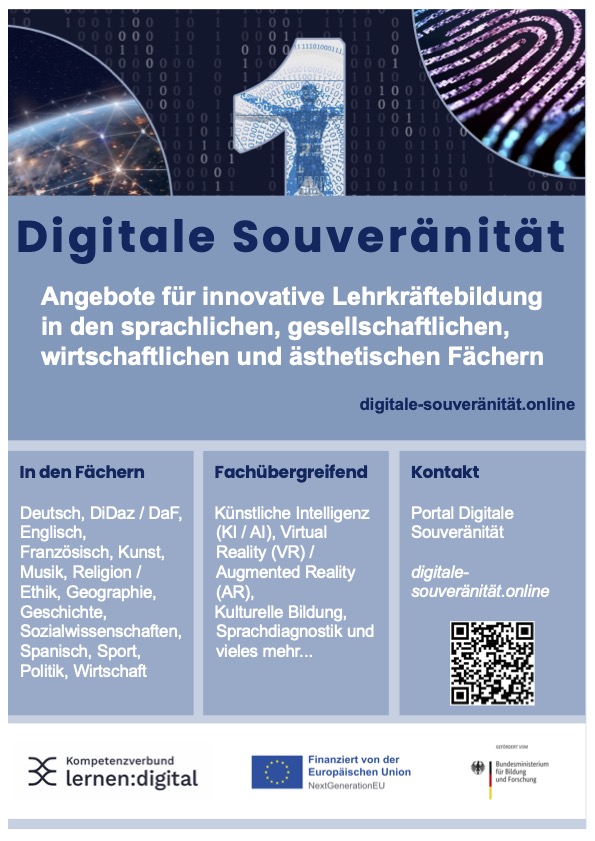
DiSo-SGW focuses on the evidence-based and research-oriented development, evaluation, and optimization of prototypical teaching approaches for the diversity-sensitive and digitality-related promotion and enhancement of teachers' professional knowledge in the digital world, focusing on languages, social sciences, and economics. This includes the long-term implementation of innovative and empirically verified teaching concepts, learning environments, and teaching scenarios for digital teaching and learning. The project is organized based on networking and cooperation between educational research, practice, and administration. For this, three development, research, and transfer groups cooperate in DiSo-SGW: EFT A (subject-specific teaching and learning), EFT B (digital tools and concepts), and EFT C (evaluation and dissemination).
EFT A develops, evaluates, optimizes, and implements concepts to promote teachers' digital competence, focusing on language, social, and economic. To this end, nine subject-specific EFT teams from science and school practice were installed, focussing on language (German, DaZ/DaF, English, French) and society/economics (geography, history, politics/social sciences, religion/ethics, economics). All nine EFT A teams aim to collaboratively develop, evaluate, optimize, and implement advanced training modules for teachers in the 2nd and 3rd phases of teacher training.
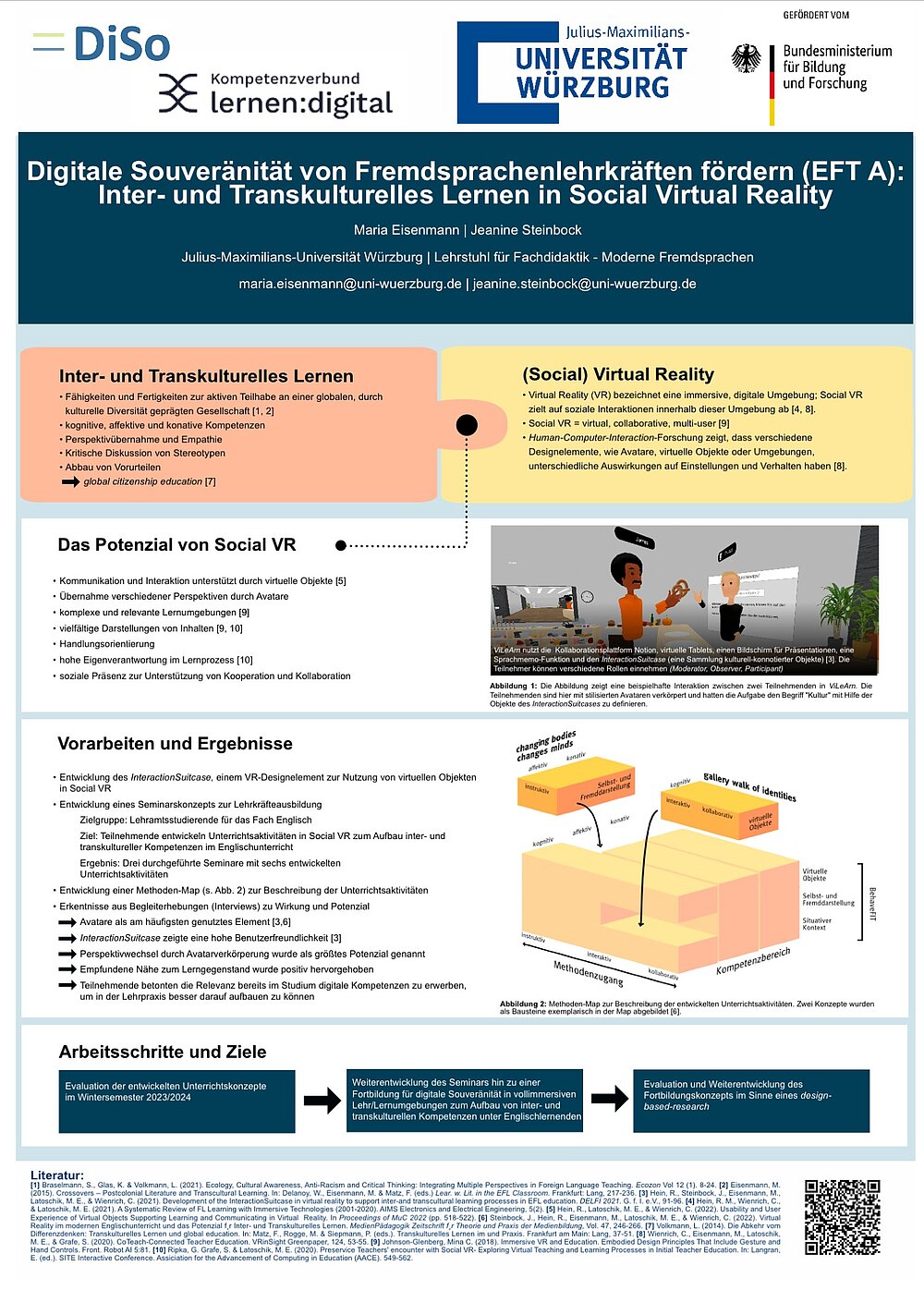
Building on the BMBF project "CoTeach - Connected Teacher Education", the sub-project at the University of Würzburg is developing an advanced training module that will enable teachers to contribute to a corpus-based and diversity-sensitive English classroom to expand inter- and transcultural competences using social virtual reality (SVR) as part of an ethical-reflexive digital literacy. The aim is to illustrate how VR technologies enable a reflection of the multimedia, multimodal, interactive, and communicative everyday life and the English classroom through presence, immersion, embodiment, agency, and empathy so that interactions with virtual peers and objects that are beneficial to developing inter- and transcultural competences become feasible. A nationwide transfer will follow the evaluation and optimization of the training modules.
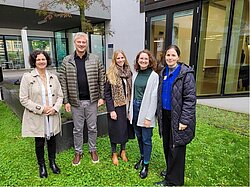
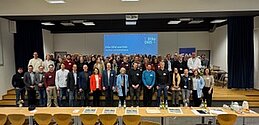
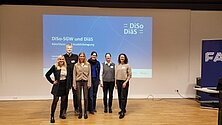
From 25 to 26 October 2023, the University of Bamberg held the kick-off meeting of the new collaborative project "DiSo-SGW" (Digital Sovereignty as an Objective of Innovative Teacher Education in Languages, Social Sciences, and Economics). On two days, participants had the opportunity to present their projects and research goals in short lectures and poster presentations and to exchange ideas with colleagues.
The Chair of TEFL methodology with Prof. Dr. Maria Eisenmann and Jeanine Steinbock contribute to "DiSo-SGW" with their project called: "Promoting the Digital Sovereignty of Foreign Language Teachers: Inter- and Transcultural Learning in Social Virtual Reality". This project focuses on promoting the digital sovereignty of English teachers in fully immersive teaching/learning environments with a focus on the acquisition of inter- and transcultural competences and global citizenship competences. The research is based on preliminary work from the BMBF project "CoTeach", in which a seminar concept was developed, where student teachers design teaching activities in social VR that promote the development of affective and conative learning goals of inter- and transcultural learning, such as the ability to adopt perspectives or curiosity about cultural diversity, but also the critical reflection of cultural stereotypes. The results of the accompanying surveys on the potential and impact of the VR environment are a basis for the "DiSo-SGW"-project in developing teacher-training modules.
For further information see: Kompetenzverbund - lernen:digital or check out the BMBF-Projektheft: "Kompetenzzentren für digitales und digital gestütztes Unterrichten in Schule und Weiterbildung"
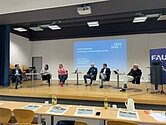
On 27–28 October 2025, the final conference and future outlook of the DiSo project took place at FAU in Nuremberg.